
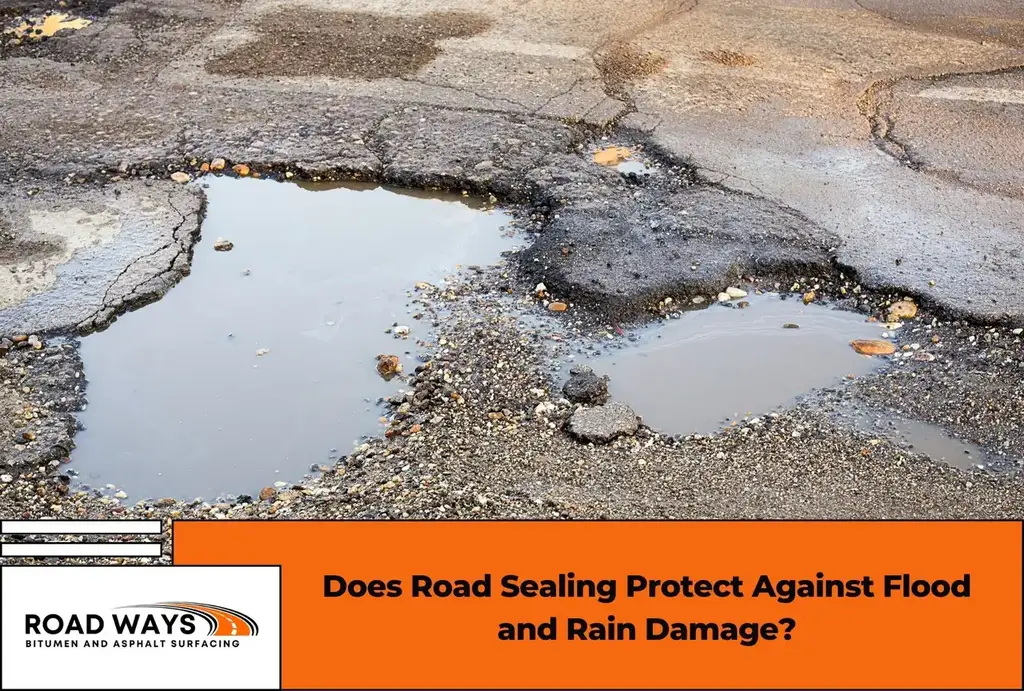
Yes, but only partly, and the gap between partly and fully is where most of the damage happens.
Road sealing gives a surface flood and rain protection by stopping water getting into the pavement from above. That matters more than it sounds, because water in the base and subgrade, not water sitting on top of it, is what turns a sound road into potholes. What a seal can't do is stop water arriving from the side, stop it pooling because the falls are wrong, or keep it out during days of submersion.
Here's how the protection works, where it runs out, and what to look for once a wet season is over.
What happens to an unsealed road surface in heavy rain
Rain lands straight on the wearing course and soaks in.
On a gravel road the fines that bind the surface together wash out first. Water then runs across the top, scours channels into it and carries material downhill. Once the surface softens, every vehicle that drives over it pushes ruts deeper and pumps more water into the layers below.
Recovery usually means re-grading and importing fresh material, and after a big event that has to happen across long stretches at once.
It's a real enough problem that Queensland's Department of Transport and Main Roads lists sealing unsealed road sections as one of the measures it uses to make the state road network more flood resistant. The case for bitumen for rural roads in wet country rests largely on this.
How a road seal keeps water out of the pavement structure
The seal works as a waterproof skin over the layers that carry the load.
A sprayed seal is binder and aggregate laid over a prepared surface to form a continuous, impermeable layer. Asphalt does the same job with a denser mix. Either way, the point is that rain hitting the surface runs off it rather than through it, and how road sealing works comes down to keeping that skin intact.
That keeps the base and subgrade near the moisture content they were designed around. A granular pavement gets its strength from compacted material with a limited amount of water in it. Add water and the material loses stiffness. The seal is what holds that balance.
Why ponding still happens even on a well-sealed surface
Because shedding water and moving water are two different jobs.
A seal stops water from penetrating. It does nothing to move water off the surface. That's the work of crossfall, longitudinal grade, table drains, kerbs and culverts, which are designed into the road rather than sprayed onto it.
So a puddle sitting on a sealed road after rain is usually telling you about the shape of the surface or a blocked drain, not a failed seal. It's still worth acting on, because standing water finds any crack or joint eventually. Getting the drainage design for sloped surfaces right is the fix, not more sealing.
What flood damage looks like once the water recedes
Often, not like much. That's the part that catches people out.
Research funded by Austroads and the ARRB Group, carried out with Griffith University on Brisbane City Council and Roads and Maritime Services roads after the January 2011 South East Queensland flood, tested sealed local roads with a falling weight deflectometer. On flood-affected sections it recorded subgrade CBR reductions of up to 67 per cent and structural number reductions of up to 50 per cent.
Over the same period, the visible surface condition showed only a marginal change in roughness, rutting and cracking.
Put plainly, a road can lose a large share of its load-carrying capacity while still looking serviceable. The researchers made the point directly: after an extreme weather event the damage may not be visible without testing, because it can sit entirely in the structure.
Does road sealing fully prevent flood damage, or just reduce it
It reduces it. Nothing makes a surface floodproof, and any contractor telling you otherwise is selling something.
Prolonged submersion gets water into the pavement regardless of how good the seal is. It comes in through the unsealed shoulder, up through the subgrade as the water table rises, along the edge where the seal terminates, and through any crack or joint that's already open.
The way the state road authority approaches it is a useful guide. TMR's flood resilience program treats sealing as one measure among several, alongside raising road levels, installing larger culverts, improving drainage and floodways, stabilising slopes and protecting batters. Sealing is part of the answer, not the whole of it.
How drainage design works alongside sealing to manage heavy rain
Sealing handles the vertical path. Drainage handles everything else.
Crossfall moves water sideways to the edge. Longitudinal grade moves it along. Table drains, kerbs and inlets collect it, and culverts carry it under the road instead of over it. Subsurface drains deal with what gets in anyway.
Shoulders deserve particular attention, because a sealed carriageway with an unsealed shoulder leaves the edge of the pavement exposed. Water runs off the seal and straight into the material beside it, then works sideways under the seal. Edge failure on an otherwise sound road usually starts here.
Warning signs a sealed surface has been compromised by water
Walk it and look for:
- Cracking along the edges, or crocodile patterns in the wheelpaths, which points to fatigue from a weakened base
- Loss of aggregate from the seal, leaving patches of exposed binder or bare base
- Rutting or depressions that hold water after rain
- Soft or spongy areas that move underfoot or under a vehicle
- Potholes forming around joints, edges and existing patches
The Australian research also found that flooded pavements deteriorate rapidly rather than gradually, which is not how most road deterioration models assume things go. A surface that looked acceptable at the end of a wet season can decline quickly through the following year.
When to get a sealed surface inspected after a flood event
Twice, if you can.
The first inspection comes once the water has gone and the surface is dry enough to walk properly. You're looking for the obvious: scouring, edge loss, potholes, missing aggregate, blocked drains and culverts. While the pavement is still saturated, keep heavy vehicles off it if there's any way to do that, since saturated layers deform under load far more easily than dry ones.
The second comes several months later, and it's the one people skip. Given that structural damage can run well ahead of anything visible, a follow-up check through the following dry season catches the deterioration that the first inspection couldn't see. Building it into regular inspections for road sealing costs almost nothing next to a reconstruction.
Resurfacing decisions are worth delaying until you have both looks. Sealing over a base that's still soft locks the problem in.
Getting a surface checked
If a road, access track or driveway has been through flooding or a hard wet season, the useful step is having someone who works with pavements walk it and give you a read on the condition, rather than waiting for the potholes to make the decision for you.
A qualified contractor can tell you whether the seal has done its job, whether the damage is on the surface or underneath, and whether the sensible move is a repair now or a proper look in six months.