
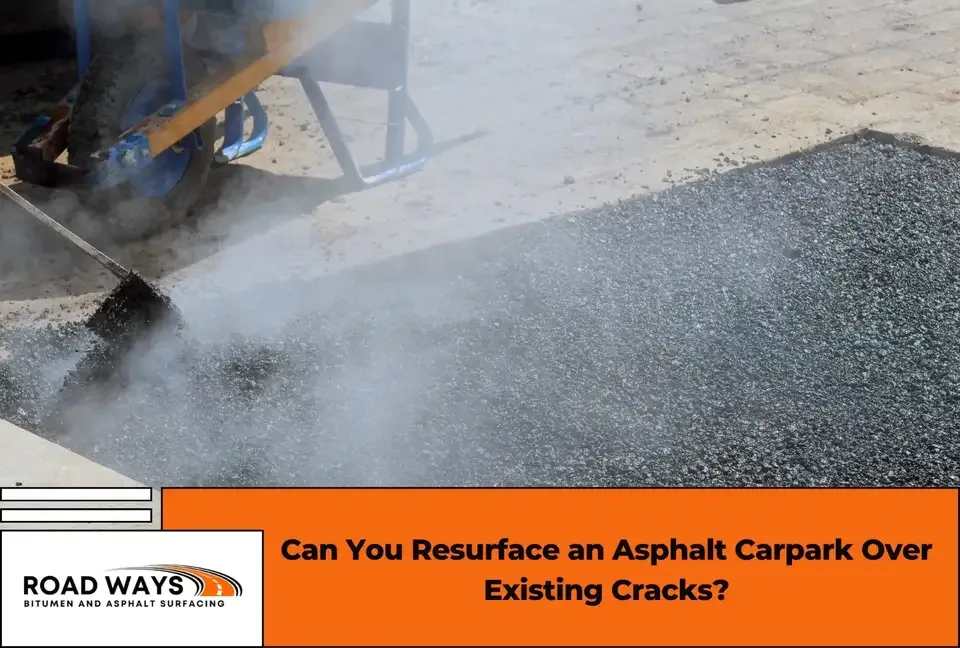
Usually, yes. Asphalt carpark resurfacing over an existing surface is standard practice, and for plenty of cracked carparks it's the sensible call. It depends entirely on what the cracks are telling you.
Hairline and surface-level cracking is a surfacing problem, and an overlay deals with it properly. Interconnected cracking spread across the bays is a structural problem, and laying fresh asphalt over the top of that buys you a tidy-looking carpark for a while and not much else.
Nobody can answer this from a photo. Here's how the assessment works in practice, so you know what a contractor should be checking, and why the answer might not be the one you were hoping for.
What determines whether resurfacing over cracks will work
The condition of the layers underneath. Everything else is secondary.
An asphalt overlay is a surfacing treatment. It restores the look, the ride quality and the waterproofing of the top layer. It doesn't add meaningful structural capacity to a base that's already failing.
So the question a contractor is working to answer is a narrow one: are these cracks the surface wearing out, or the pavement underneath giving up? The Austroads Guide to Pavement Technology Part 5 makes the point directly, that if the cause of the distress is misread, the treatment is unlikely to perform no matter how well it is designed or laid.
That is the entire assessment in one sentence.
What type of cracking rules out a simple overlay
Interconnected cracking is the one that changes the answer.
Austroads sorts cracks into three groups: linear cracks running in one direction, interconnected cracks in crocodile or block patterns, and irregular cracks. Crocodile cracking, which you'll also hear called alligator cracking, is the pattern that looks like reptile skin. It's fatigue cracking. It means the pavement has been flexing under load harder than it was built to cope with.
Where that shows up along the bin truck path, the delivery bay or the entry crossover, an overlay on its own won't fix it. Those areas need the base repaired first.
Single straight cracks, shrinkage cracking and fine surface crazing are a different matter, and in most cases they're fine to resurface over.
How is the existing surface assessed before resurfacing
On foot, and ideally after rain.
A pre-resurfacing assessment should cover the type, width and pattern of the cracking and where it sits on the site. It should pick up potholes and any areas already patched. It should record depressions, rutting and ponding, which point to base or drainage trouble rather than ordinary surface wear. And it should take in the condition of the drains, grates, kerbs and falls.
Ponding is the one owners tend to wave off. Water sitting on the surface after rain means the shape has gone somewhere, and shape loss comes from below.
On larger sites, a contractor may core the pavement to confirm layer thicknesses rather than assume them.
Does an overlay stop cracks from coming back through
Not on its own. This is reflective cracking, and it's the main risk with any overlay.
Existing cracks keep moving. When the layer below shifts under traffic or temperature change, that movement transfers up through the new asphalt and the old crack pattern reappears on the fresh surface. The new layer hasn't failed. It's tracing what's underneath it.
There are two ways to manage it: treat the cracks properly before laying, or put an interlayer between old and new. Austroads covers strain alleviating membranes and geotextile reinforced seals for this exact purpose. They cut the risk down. They don't remove it.
How quickly cracks work their way back through depends on the site and the extent of the underlying damage.
What is the difference between an overlay and full reconstruction
An overlay leaves the existing pavement where it is. Reconstruction takes it out.
| Overlay | Full reconstruction | |
|---|---|---|
| What happens | Fresh asphalt laid over the prepared existing surface | Existing surface and failed base removed, pavement rebuilt |
| Suits | Sound base, surface-level cracking | Widespread base failure, deep rutting, drainage needing re-grading |
| Levels | Raises the finished surface height | Keeps the original levels |
| Disruption | Shorter, easier to stage around trading | Longer, larger area out of use at once |
Reconstruction gets recommended when the failure is widespread rather than patchy. If a third of the carpark is cracked through to the base, patching around it and overlaying the rest becomes a false economy, and the carpark resurfacing cost per square metre stops being the number that matters.
How thick does an asphalt overlay need to be over an old carpark
There's no single figure, and a contractor quoting one before seeing the site is guessing.
Thickness follows the traffic the carpark carries day to day. A staff carpark taking passenger vehicles is a different design problem to one handling semi-trailers, waste collection trucks or bus movements. Turning and braking loads at entries and loading docks are harder on asphalt than straight-line travel, so those zones often get treated differently to the open bays.
Levels constrain it as well. Austroads flags kerb and channel, drainage inlets and clearance to overhead structures as limits on how much depth you can add. In a carpark that also means door thresholds, grate heights and the gradients on accessible parking bays, which can't be raised past what the standards allow.
What happens if the base underneath is damaged
It gets repaired first, or the overlay fails early.
Skipping base repair is the most common reason resurfacing doesn't last. The failed area keeps moving under load, the new asphalt above it cracks and dips within a season or two, and you're back where you started with the resurfacing budget already spent.
Base repair usually means cutting out the failed sections to full depth, rebuilding and compacting the pavement layers, then resurfacing the whole area so the finish stays consistent. Austroads treats this as heavy patching, a strengthening treatment rather than routine maintenance.
Drainage belongs in the same conversation. If cracking has been letting water into the base, and the falls or the grates aren't clearing it, resurfacing over the top seals the symptom and leaves the cause sitting there. Austroads lists ponding and depressions that hold surface water among the conditions behind moisture-related failure, alongside stripping, rutting and potholes. The same logic applies when you're preparing a surface before resurfacing over concrete.
Base repair adds cost. It also decides whether the resurfacing lasts.
How long does an overlay last compared to full reconstruction
A well-laid overlay on a sound base gives you solid service. Reconstruction gives you more, because you've replaced the whole pavement structure rather than the top of it.
Putting firm numbers on either is where most articles start inventing things. Service life shifts with traffic loading, mix design, drainage, climate and how the surface is looked after afterwards. A carpark taking daily truck movements will not track anything like a low-use office lot, and ongoing carpark maintenance makes a real difference to both.
What holds up is the comparison. An overlay costs less up front and performs well when the diagnosis is right. When the diagnosis is wrong, it's the most expensive option on the table, because you end up paying for the job twice.
Get the carpark assessed before you assume either way
Most cracked carparks can be resurfaced. Some can't, and the difference isn't something you can pick from the office window.
If your surface is cracking, the useful next step is having someone walk it, read the crack pattern, check where water sits and tell you plainly which option the site needs. You can request a carpark assessment and get that in writing before you commit to a budget.
The Australian Flexible Pavement Association is the industry peak body if you want to read further on how flexible pavements are designed and maintained in Australia.