
You can lay asphalt over existing concrete, and done right it gives you a smooth, fresh surface without the cost and disruption of ripping the whole slab out. The word that matters is "right". Most overlay failures, peeling, cracking, patches lifting, trace back to skipped preparation. Here is what proper prep involves.
Inspect the concrete first
Before anything, the slab has to be judged fit for resurfacing. We look for structural movement, moisture and uneven levels. Hairline cracks are usually manageable, but wide fractures or sections that move under load mean the base has failed, and no overlay will fix that. Uneven areas need levelling, and any damp or trapped water has to be sorted before work goes ahead. A lightly roughened surface profile gives the new layer something to grip.
Clean it thoroughly
Any dust, oil or residue left behind weakens the bond and leads to peeling. The surface gets a pressure wash, a concrete-safe degreaser on any oil or fuel stains, and mechanical grinding to strip off old paint, sealers or coatings. Weeds and moss come out of the cracks and joints. Then it dries completely, because moisture trapped under asphalt becomes vapour and ruins the bond.
Repair cracks, joints and defects
Any weakness in the concrete reflects straight through the new asphalt, so defects get dealt with first. Cracks are sealed with a flexible filler or epoxy, wider or moving cracks get a joint filler that can handle movement, and chips and spalled edges are patched with a polymer-modified mix. Active expansion joints are cut alongside and filled to reduce reflective cracking. Badly damaged sections are removed and patched before we go any further.
Check and fix drainage and levels
Water that pools or runs the wrong way undermines the bond and shortens the life of the overlay. We check the fall, correct low spots with levelling compound, and make sure the surface sheds water towards drains and channels. On sites that hold water, edge drains or grated channels help direct flow away. Given our rainfall, drainage is not optional.
Apply a bonding tack coat
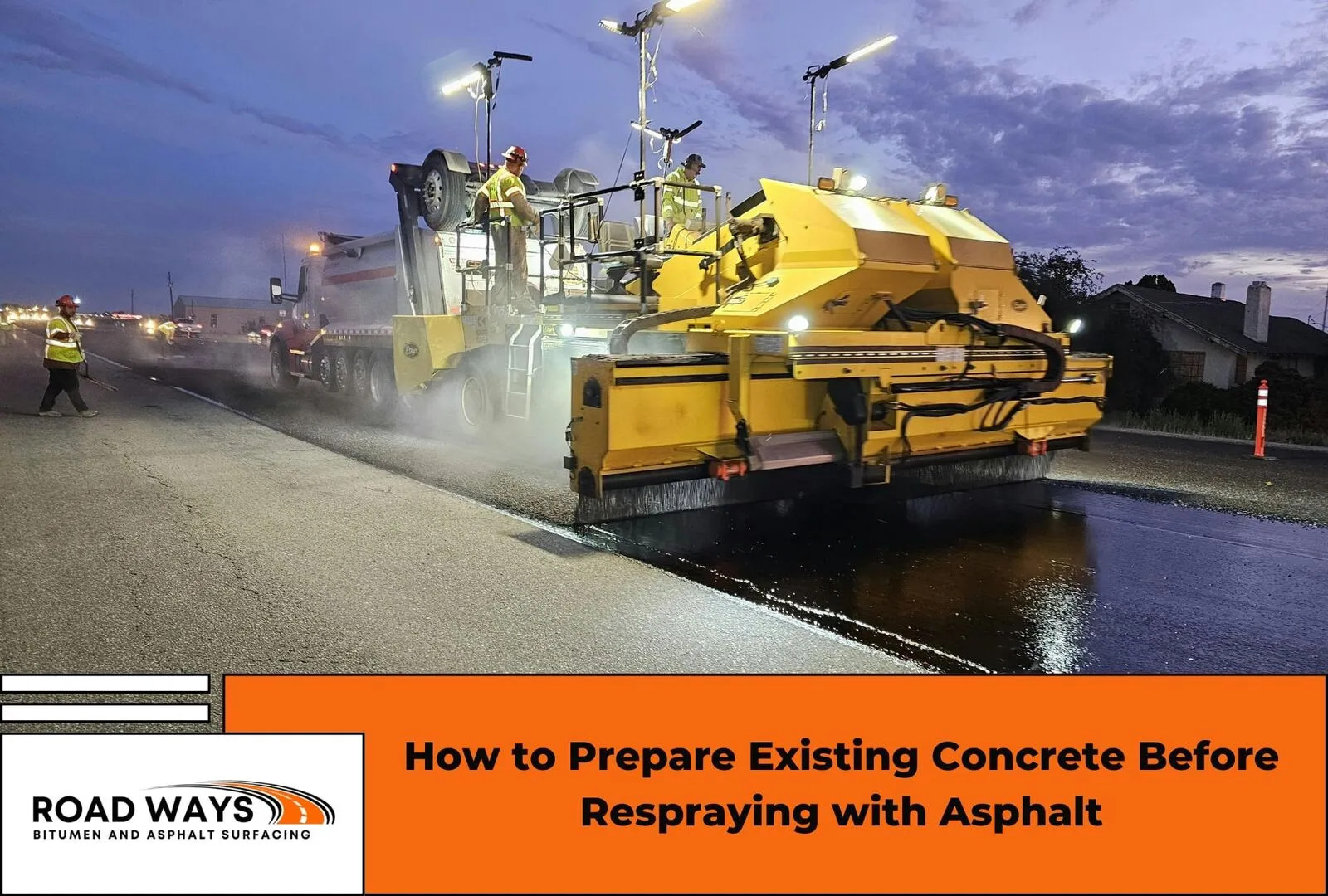
A tack coat is the glue between the old concrete and the new asphalt. We use a bitumen emulsion or prime coat made for concrete-to-asphalt work, sprayed evenly onto a clean, dry surface, and lay the asphalt while it is tacky but not fully dry. Skip this and the overlay can shift, peel or crack early.
Level, then lay the right thickness
If the surface is uneven, a levelling course evens it out before the top layer. Thickness is matched to the job: a residential asphalt driveway wants around 30 to 40mm, while access roads and commercial areas need more. A final quality check confirms repairs are cured, the surface is even, drainage is clear and the weather is right, before a single load of hot mix goes down.
Good preparation is the whole game. It is where a resurfacing job either becomes a durable surface or an expensive redo. We handle concrete-to-asphalt resurfacing across Brisbane, the Gold Coast, Ipswich, the Sunshine Coast and Toowoomba.
Thinking about resurfacing an old concrete drive or car park? Get in touch and we will assess it and give you a free written quote.