A fresh bitumen driveway is one of the best upgrades you can make to a Queensland property. It handles the heat and the downpours, and it looks a lot better than cracked concrete or a dusty gravel track. But before the crew turns up, there is always one question: do I need to ask the council first?
The short answer is usually yes, but mainly for the part that touches their land. Here is how it works across most Queensland councils, from Brisbane and the Gold Coast to the Sunshine Coast, Ipswich and Toowoomba.
The crossover versus the driveway
Most people call the whole run from the garage to the road the driveway. Councils split it in two.
- The crossover (or vehicle crossing) is the section between your property boundary and the road. Even though you pay for it, it sits on council land.
- The driveway is the part on your own private property.
For the crossover, you need a permit
Every local government in Queensland has rules for the crossover: how wide it can be, how close it can sit to a street tree, and what materials are allowed. That means an application, whether you are in Brisbane City, the Gold Coast, or a regional council. Build one without approval and the council can make you rip it up at your own cost.
For the driveway, usually not
The part on your own land generally does not need a specific building permit, as long as you are not changing ground levels significantly or redirecting stormwater onto a neighbour's block. Some councils may require development approval if the driveway is very large or affects drainage, so it is worth a check.
Why councils like bitumen
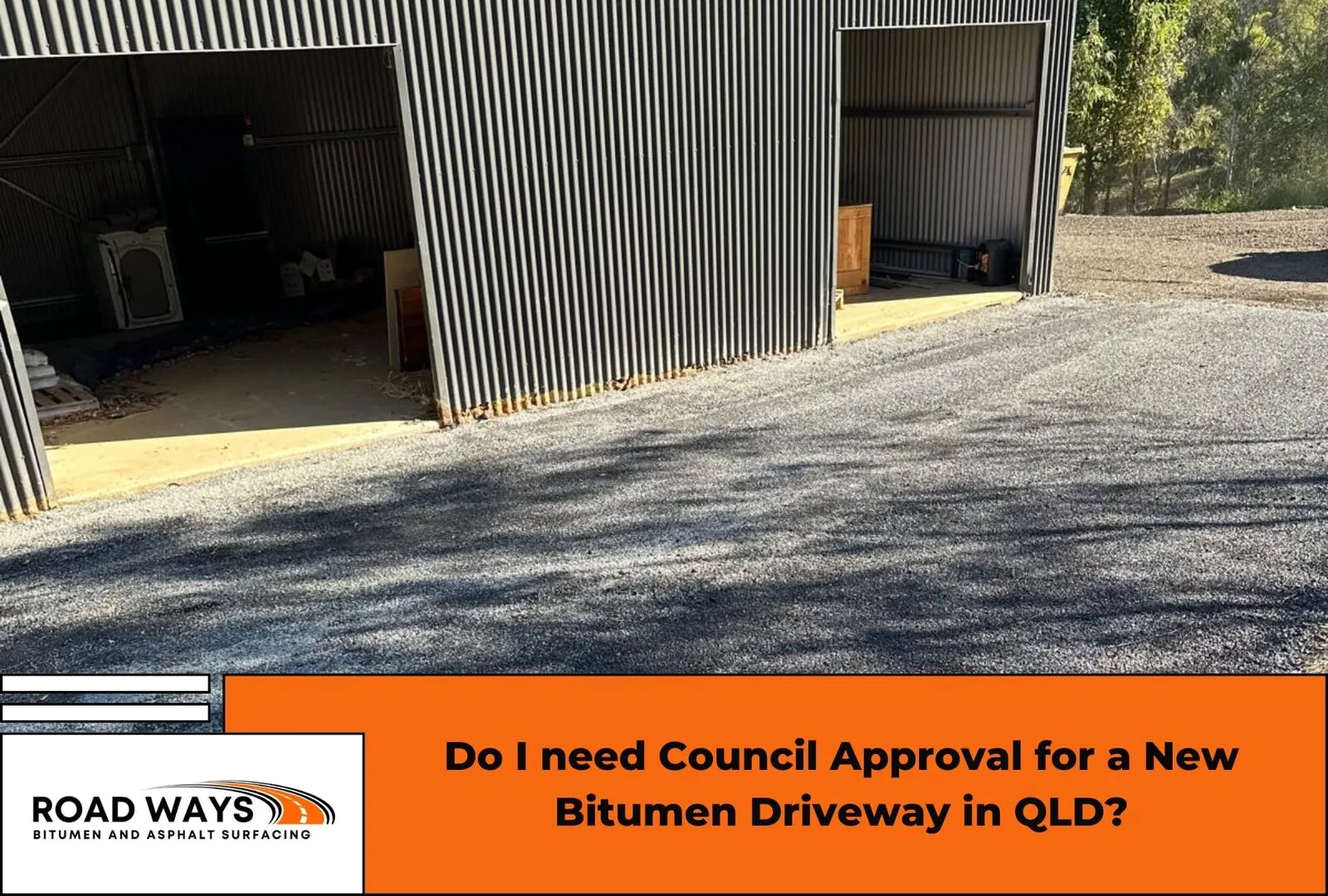
Councils can be fussy about materials. Loose gravel washes into stormwater drains in a Queensland downpour, and we get plenty of those. Bitumen is a sealed surface that stays put, which is why it ticks the box. When we lay bitumen driveways, we build to the crossover specifications councils expect, which usually means a solid compacted road base under the seal.
What the council will check
- Drainage: you cannot just aim runoff at the road and hope. Our rainfall makes proper drainage essential.
- Sightlines: can you see oncoming traffic, and can they see you, when you pull out?
- Distance from services: clearances around power pits, water meters and the like.
- Environmental conditions: coastal and sensitive areas can carry extra stormwater requirements.
How to stay out of trouble
Check your council website for the vehicle crossing or driveway permit form, submit a simple sketch showing the location and width, and pay the application fee. Once approved you usually have a set window to get the work done, and some councils inspect the finished job.
Navigating the paperwork while deciding between a two-coat seal and asphalt can be a headache. We work right across Queensland and know what local inspectors look for. Contact us and we will look at your block, sort the specs, and give you a straight-up free quote.